


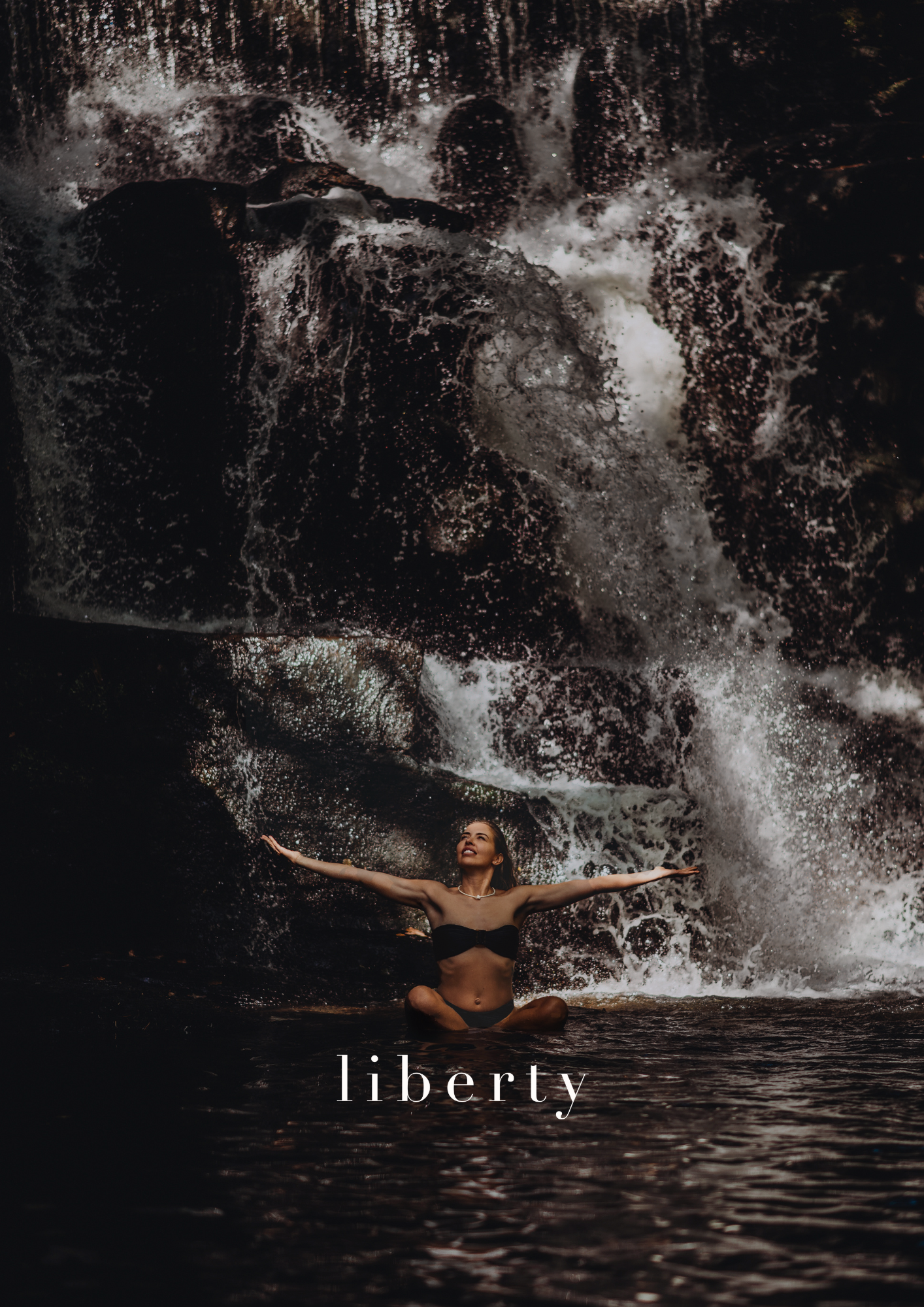

I didn’t start Liberty because I had some big vision of a photography empire or because I knew exactly what I was here to do. If I’m honest, it started much earlier than cameras, and much messier than a business plan.
I used to work in Phones 4u — for my sins — and actually, I loved it. I really loved it. I loved selling, I loved people, I loved the buzz of a busy shop, I loved talking to strangers and hearing their stories. We would sell ten phone contracts on a Saturday like it was nothing, and it always felt easy and fun. I wasn’t scared of people. I never have been. I loved meeting them, connecting with them, making friends, hearing about their lives. Looking back now, I can see that I was already very comfortable with energy, volume, movement, and being “on” in a way that didn’t drain me — it fuelled me.
I think because I got used to working with big numbers of people, I later felt happiest photographing big numbers of women. That dynamic, high-energy environment always felt like home to me. Selling phones obviously wasn’t what I was here to do forever, but at the time it gave me something incredibly valuable: a deep understanding of humans. How they talk, how they hesitate, how they decide, how they trust, how they open up when they feel safe.
Alongside that, I trained as a volunteer and worked with the Stroke Association, supporting people who often couldn’t communicate easily. That experience taught me something profound: listening isn’t about waiting to speak, and it certainly isn’t about fixing. We were there simply to listen, to be present, to witness people without rushing them, correcting them, or trying to make their experience more palatable. That skill alone shaped everything that came later.
Not long after, I volunteered as a breastfeeding supporter with the Breastfeeding Network. I was young — around 25 — and suddenly immersed in rooms full of women, bodies, emotions, vulnerability, exhaustion, power, pain, love. We had to train in counselling skills, including active listening, and learn how to hold space without advice-giving or rescuing. We weren’t there to fix women; we were there to trust them.
And that mattered. Because so many adults — even now, even much older than me — still rush to fix instead of listening. That experience quietly set the foundations for Liberty: the idea that you are not broken, you are not a problem to solve, and you do not come here to be fixed. You arrive whole. Every past version of you, every future version of you, already exists within you.
Around that time, Instagram appeared, before anyone really knew what it was. I started taking photos on my phone and sharing them — ordinary moments, children, people, life — and people kept asking me who had taken the photos, who my photographer was. I’d say, “It’s just me. I took them on my phone.” Eventually, someone asked me to photograph their wedding based purely on those images. The quality wasn’t technically brilliant, but there was love in them. Connection. Feeling.
I was a photographer before I ever called myself one.
My ex-husband bought me a camera because he could see how much I loved it. And then — like so many people — I left it in a drawer for months. I was terrified of trying and failing. I didn’t want it to become another thing I wasn’t good at.
Then one night, I read The Element by Ken Robinson, and it changed everything. He talked about Matt Groening doodling through every class at school, only to be told by his art teacher that his work was “too cartoony” and that he’d never make it. That single opinion nearly shut something down forever. And I realised — with absolute clarity — that I had stopped making art for over a decade because of one teacher’s opinion. That realisation woke me up at four in the morning, the way real truths do.
I asked myself: Who am I making art for? Her? Or the eight-year-old version of me who made art simply because it was fun?
That child didn’t care if it was good enough. She just made it.
I even reached out to my old art teacher and asked him to give me a project, almost like I needed permission. He never replied. And somehow, that was the permission.
Not long after, someone asked me to photograph a breastfeeding shoot for charity. I said yes — “fuck it” — and I did it. Then I did another. One raised no money because someone stole it, which was awful, but I kept going anyway. I started something called Jennifer’s Photo Documentaries, deciding to take one photo a day for a year and see where it led.
Within three months, Dimples & Daisies was born.
Within six months, I was booked three months in advance.
Within a year, I had to choose between slowing down or hiring — and I didn’t want to slow down.
So I hired.
And then, about a year later, I felt an ache. I didn’t have the language for it at the time, but I knew something was missing. I saw a photograph of a woman looking over her shoulder — not sexual, just radiant, content, alive — and something clicked. I didn’t want to photograph women through the male gaze. I wanted to show them their light. I wanted them to feel beautiful, empowered, sexy, enough, seen, heard, important. I wouldn’t have used this language then, but I wanted women to feel like the main character in their own story again.
That was the birth of Liberty.
I dragged six women into a field, paid for the location, paid for an MUA, and photographed them. They were hesitant, unsure, but something happened. The next shoot had twenty women. That’s when I knew it wasn’t just me — it was a thing.
Not long after, we introduced the Liberty Circle. Shoots had always been group-based, but we realised that once you hear a woman’s story, once you see her through the lens of her lived experience, photographing her becomes effortless. It’s like falling in love — you see all of her. The circle became non-negotiable. Even now, after lockdown forced a pause, every shoot begins with it again.
Then came 2020.
We scaled too fast. Too many people. Too much structure. Sixteen staff at one point. And the biggest mistake of all — I removed myself from the women. From the photography. From the thing I loved. I became a manager instead of a creator, drowning in admin and leadership roles I didn’t actually want. What I really needed was a business manager, but at the time that felt like a bigger risk than hiring photographers.
I learned a lot of very hard lessons very quickly. Now, I have one incredible team member handling admin and customer journeys — and that’s enough.
I can’t tell this story without talking about Holly. We worked together at Phones 4u. About a year into Liberty, I saw her across a room at a party and had an absolute knowing that I needed her. She did one shift for me, and the same week Phones 4u went into liquidation. She was offered a job elsewhere for £300 a month, and I told her honestly that I couldn’t promise that — but I would try. And I always paid her. She grew with the business, and now she’s thriving in her own right.
Over time, though, I noticed Liberty drifting. The shoots became sexier — not in a bad way, but in a way that no longer aligned with the original intention. Sexy happens naturally when women feel free, but it was never meant to be the goal. Reclaiming my camera and my stage was one of the hardest things I’ve ever done. It kept me awake at night. But I realised I couldn’t tell women to centre themselves in their own lives if I wasn’t willing to do it myself.
Leaving your stage means leaving your power behind. And I knew then, it was time for me to take mine back. It was time for me to be at the heart of Liberty again.
Then came 2024, which was brutal. We barely broke even. I was deeply depressed — existentially depressed. The business flatlined. And yet, in that stillness, something extraordinary happened: clarity. I knew exactly what Liberty was meant to be again. I knew I wanted it global — but not by employing people. By teaching a framework. By creating a dream big enough to hold other women’s dreams inside of it.
That clarity felt like starting over. I stripped everything back. Removed what didn’t work. Rebuilt with intention. I haven’t lost that clarity since.
This year, we relaunched. Half of 2026 sold out in a month. And now my next mission is onboarding Liberty photographers — not staff, but leaders — women running their own Liberty shoots within a shared framework.
This is Liberty’s origin story. A rebirth — for me, and for the women who will carry it forward.

You are so interesting! I do not think I have read through a single thing like that before.
So wonderful to discover someone with unique thoughts on this
subject. Really.. many thanks for starting this up.
This website is something that’s needed on the internet, someone with some originality!
So glad you enjoyed it and thank you so much for your comment – that means the world!
Enjoy the website and hope to see you on a shoot soon xx